Showing posts with label 19th century. Show all posts

Saturday, October 5, 2013

Review: Crossing Purgatory, by Gary Schanbacher


Share 


CROSSING PURGATORY
by Gary Schanbacher
Pegasus, 2013
Hardcover, 336 pages
9781605984438
$25.00 (US)


In May of 1858, Thompson Grey abandons his farm in Indiana, unable to live in the present and inconsolable after the death of his wife and two children. He feels responsible, believing his lust for a better life killed his family, and walks away full of thoughts about his empty life.

There can be no words to describe Thompson’s deep sense of guilt and self-loathing, but Gary Schanbacher gives readers a rare glimpse into a man’s emotional battles: “Dream world or real? … He fought to relegate his dark epiphany to the realm of drifting and unreliable imagination… The world took shape … but the truth remained before him, ox-like, stubborn, massive and accusing.”

CROSSING PURGATORY is the hellish self-imposed journey Thompson takes as he grieves daily, directionless, haunted by nightmares and restless nights. Bereft of everything he loves, he prefers the open space of the outdoors. Perhaps his purpose is to find his lost soul. He is confronted by Captain Upperdine, a wagonmaster leading immigrants to a new life out West along the Sante Fe Trail. Upperdine, puzzled by the taciturn farmer, relays the perils of the unforgiving climate and convinces Thompson to help him manage his party across the country.

As his wagon train diminishes in size, Upperdine leads Thompson and one remaining family to his home to rest and make plans. Upperdine has an Indian wife, who provides some security from her people and protection for his vast land holdings. The land isn’t suitable for crops, but Thompson devises a plan to farm the barren land for profit. Unsure about his future and driven by blinding ambition, he is tempted to revisit his past.

Gary Schanbacher strips Thompson Grey down to his intimate, unfiltered thoughts. Readers will savor this beautifully rich historical novel, a work whose literary future is assured. Schanbacher’s clear writing illuminates many precise visual details. Take this one on vacation this summer.


Disclosure: I received a copy of this book from HNR to write a candid review for publication. 

© [Wisteria Leigh] and [Bookworm's Dinner], [2008-2013]. Unauthorized use and/or duplication of this material without express and written permission from this blog’s author and/or owner is strictly prohibited. Excerpts and links may be used, provided that full and clear credit is given to [Wisteria Leigh] and [Bookworm's Dinner] with appropriate and specific direction to the original content.


Tuesday, January 22, 2013

REVIEW: FREEDOM'S CAP By Guy Gugliotta

Share

FREEDOM'S CAP: THE UNITED STATES CAPITAL AND THE COMING OF THE CIVIL WAR

Guy Gugliotta
Hill and Wang
Hardcover, $35.00
February 28, 2012
978-0809046812


FREEDOM'S CAP is a remarkable historical narrative about the building of the nation’s capitol with a simultaneous counterpoint to the tearing down of the Union. Gugliotta outlines the political parties and their platforms with clear prose. As 1850 unfolds, the divisions that exist among the North and South are complex, yet Gugliotta crafts a unique package of history and intrigue that shows this writer’s artistry.
Personalities step out and breathe as he captures the political battles in Congress. The subterfuge among the three key men responsible for the magnificent building would make an ideal movie. Montgomery Meigs and Thomas Walter battled for credit and control. Until Jefferson Davis left Washington to lead the Confederacy, he was the most steadfast supporter of the project. It was an ongoing battle of wills and wit that encompassed many years. My one complaint is that readers may be misled by its title.  FREEDOM'S CAP is a page-turner, despite its lackluster title. Gugliotta has blown the dust off American Civil War history shelves to make room for his exceptional addition.


January 22, 2013
Wisteria Leigh


Disclosure:
The copy of this book was provided by HNR for review and publication. The review is submitted without bias. 


As it appeared in Historical Novels Review:August 2012 Issue 61 available at  
http://historicalnovelsociety.org/reviews/freedoms-cap-the-united-states-capital-and-the-coming-of-the-civil-war/


© [Wisteria Leigh] and [Bookworm's Dinner], [2008-2013].


Saturday, December 22, 2012

The Last Runaway, by Tracy Chevalier

Share


The Last Runaway 
Tracy Chevalier 
Dutton Adult (2013),  
Hardcover ISBN 0525952993 
320 pages 
$26.95/$28.50CAN


Tracy Chevalier is a familiar author to me.  Girl With a Pearl Earring still stands out as one of my favorite historical fiction selections. The Last Runaway takes place prior to the American Civil War in the border state of Ohio. Honor Bright left her homeland of England to travel with her sister Grace to America.  Shortly after their arrival Grace dies leaving Honor in a tenuous position regarding her future. Honor Bright is a Quaker and  holds dear the tenets of her religion. She values honesty and abhors slavery.  She marries Jack Haymaker, a dairy farmer and moves in with him, along with his sister and mother. Honor finds herself in a perfect position to help runaways who travel along the Underground Railroad. The Haymaker family pretend not to notice Honor's small contributions of assistance until one day they forbid her to continue. Honor Bright is forced to make difficult decisions that cause great internal conflict and reflection.

The character of Honor Bright is eerily familiar as if this writer were in her shoes in a previous life. Belle, a milliner is spunky and frank and her friendship with Honor is genuine. More than once she manages to surprise Honor with her prowess with a shotgun.  The importance of quilting and hatting in America, women's roles, Quakers and The Underground Railroad, particularly the ramifications of the Fugitive Slave Act in Ohio provided Chevalier with background to write this beautiful and inspiring novel. An author's note of interest Ms. Chevalier learned to quilt in order to write The Last Runaway.  I’m sure a gratifying p
erk she had not anticipated. 

Disclosure: A copy of this book was received as an ARC from the publisher. This review is my candid and unbiased opinion. 


© [Wisteria Leigh] and [Bookworm's Dinner], [2008-2012].  


Tuesday, July 17, 2012

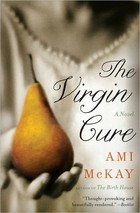
The Virgin Cure, by Ami McKay- TLC Book Tour

Share 
THE VIRGIN CURE
Ami McKay
Harper Collins 
June 26, 2012, 
HC, 336pp,  
978-0061140327
$25.99.


\
Is it possible that men really believed that by taking the maiden head of a young woman he would be cured of a host of socially transmitted diseases, most importantly, the pox?  Ami McKay has created a heartfelt story a young girl named “Moth.” She was abandoned by her father, and at the age of twelve was sold by her mother to a wretched wealthy woman who abused her with sadistic pleasure. Moth breaks free but her theft of a bracelet will only last so far. The year is 1871 and McKay depicts the horrors of life on the streets for thousands of young children who stayed alive by any means possible. Moral principles succumbed to a need to survive through desperate illegal and illicit behavior.
Moth is soon befriended by a young girl who offers her a chance to get off the streets. She introduces Moth to Miss Everett, the madam of a brothel who caters to the whims of wealthy gentlemen.  They pay enormous sums to bed a young virgin. Miss Everett proudly and protectively cultivates the street girls to exude beauty and class.  The girls learn to enchant their dates with sensual tension that only furthers to increase negotiations. Moth meets Dr. Sadie, a female physician who takes care of the girls in residence.  Dr. Sadie questions young Moth’s age as her innocence is apparent beneath her bravado and intelligence. As Moth dreams of a better life, a life of independence and freedom to be herself she believes Miss Everett will provide a secure future. Dr. Sadie and Moth develop a friendship that allows her to see life outside the illusion of comfort provided by Miss Everett.
Ami McKay
Her story is easily imagined by Ami McKay’s captivating recreation of tenement life in New York.  In her author notes, she explains her motivation and research that led her to Moth Fenwick’s story. She tells her surprise at her discovery of the myth of what is called “the virgin cure.” Ami McKay’s shaping of Moth is a composite of so many young girls on the streets, homeless and doing whatever it takes to survive. Moth will be remembered for her courage and her strong voice of determination that covers up her frightened soul.  Moth walks the reader down the dirty social history of city life in the late 1800’s where countless of homeless children struggled to survive life on the streets with hard and desperate choices that often ended in tragedy.  A wonderful vivid enveloping historical fiction read.  Will no doubt present comparisons and reflection about children worldwide who struggle, fearful and alone to this day.  

Disclosure:  A copy of this book was provided by TLC Book Tours for an unbiased review.

© [Wisteria Leigh] and [Bookworm's Dinner], [2008-2012].

Follow Me on Pinterest
 

Monday, April 18, 2011

Pox, An American History, by Michael Willrich-Blog Tour


POX, An American History
Michael Willrich
The Penguin Press, March 31, 2011
400pp. HC
978-159420286


Summary from The Penguin Press (Cover Jacket)

The untold story of how America's Progressive-era war on smallpox sparked one of the great civil liberties battles of the twentieth century. 
At the turn of the last century, a powerful smallpox epidemic swept the United States from coast to coast. The age-old disease spread swiftly through an increasingly interconnected American landscape: from southern tobacco plantations to the dense immigrant neighborhoods of northern cities to far-flung villages on the edges of the nascent American empire. In Pox, award-winning historian Michael Willrich offers a gripping chronicle of how the nation's continentwide fight against smallpox launched one of the most important civil liberties struggles of the twentieth century.

At the dawn of the activist Progressive era and during a moment of great optimism about modern medicine, the government responded to the deadly epidemic by calling for universal compulsory vaccination. To enforce the law, public health authorities relied on quarantines, pesthouses, and "virus squads"-corps of doctors and club-wielding police. Though these measures eventually contained the disease, they also sparked a wave of popular resistance among Americans who perceived them as a threat to their health and to their rights.

At the time, anti-vaccinationists were often dismissed as misguided cranks, but Willrich argues that they belonged to a wider legacy of American dissent that attended the rise of an increasingly powerful government. While a well-organized anti-vaccination movement sprang up during these years, many Americans resisted in subtler ways-by concealing sick family members or forging immunization certificates.
Pox introduces us to memorable characters on both sides of the debate, from Henning Jacobson, a Swedish Lutheran minister whose battle against vaccination went all the way to the Supreme Court, to C. P. Wertenbaker, a federal surgeon who saw himself as a medical missionary combating a deadly-and preventable-disease.

As Willrich suggests, many of the questions first raised by the Progressive-era antivaccination movement are still with us: How far should the government go to protect us from peril? What happens when the interests of public health collide with religious beliefs and personal conscience? In
Pox, Willrich delivers a riveting tale about the clash of modern medicine, civil liberties, and government power at the turn of the last century that resonates powerfully today.-The Penguin Press


My Review

Cover to cover, POX will command your attention with an unyielding grip.  Who would think a history about the smallpox scourge would be so engaging, fascinating in fact?

Yet with his extensive research and well crafted narrative Willrich has accomplished that and more. When you read his book, the smallpox epidemic at the turn of the twentieth century is the focus. However, his look back prior to 1900, and then forward in time provides an important timeline and perspective. It is always interesting as a historian, to view the past with twenty-first century eyes. Fortunately, Willrich provides objectivity when writing of the past while offering opportunities to reflect and make connections to current issues facing our global community.

During the Progressive Era, social reformers were crusaders of change.  Change is not always popular and Willrich points out those wishing to change current practice had their opposition. Vaccination proponents, favoring what was in their view necessary for the common good, argued with the opponents, the antivaccinationists who believed in a person’s individual rights.

POX provides a fluid chronicle of the smallpox virus and the development of the weapon that would ultimately obliterate it’s existence around the world.  The methods state governments implemented to enforce vaccination was not always equitable.  It is alarming to read, although it should not be a surprise that our country’s marginalized population suffered most. It was a common belief that this was a  African Americans, recent immigrants, and the poor were systematically singled out and physically forced to submit to vaccination and/or quarantined within their homes or taken to pesthouses for weeks. Race, income, religion and political difference created a clear line of injustice and inequity.

POX will encourage deep reflection and inspire the curious.  Michael Willrich has written a spectacular historical narrative, an outstanding read. POX has been added to my best picks for 2011.


Michael Willrich

"Michael Willrich is the author of City of Courts, which won the John H. Dunning Prize awarded by the American Historical Association for the best book on any aspect of U.S. history, and the William Nelson Cromwell Prize awarded by the American Society for Legal History. Currently an associate professor of history at Brandeis University, he worked for several years as a journalist in Washington, D.C., writing for The Washington Monthly, City Paper, The New Republic, and other magazines."  The Penguin Press, book jacket. 


Unauthorized use and/or duplication of this material without express and written permission from this blog’s author and/or owner is strictly prohibited. Excerpts and links may be used, provided that full and clear credit is given to [Wisteria Leigh] and [Bookworm's Dinner] with appropriate and specific direction to the original content.
© [Wisteria Leigh] and [Bookworm's Dinner], [2008-2011].

Thursday, February 3, 2011

Review-Original Sins, by Peg Kingman


ORIGINAL SINS
A NOVEL OF SLAVERY AND FREEDOM

Peg Kingman
W.W.Norton and Company
2010,HC, $25.95 416pp
978-0-393-06547-3.


Grace Pollacke is an artist, she paints portraits in miniature. Her husband arrives home to Philadelphia after being in China for several years. Traveling with Daniel is Anibaddh, The Rani of Nungklow. It is not the first time she has been in America for she is a runaway slave from Virginia. At great personal risk she has returned to establish a silk business, but this raises suspicion in Grace.

Grace, is a woman with a sharp intellect, well read in politics and literature, a rare find in 1840. Her current patron is Mrs. Ambler who is accompanied by her sister Mrs. MacFarlane. Engaged in a conversation about religion and slavery, Grace becomes disturbed with her subject, as her views are completely contrary. Anibaddh overhears the women and immediately recognizes their voices. They are the daughters of Judge Grant of Grantsboro Plantation and therefore Grace’s cousins.

When Grace steps in harms way to save her son, she realizes why Annibadh has returned. There could be only one reason she would risk her own life to sacrifice freedom: a child. Unaware of their common ancestral lineage, the woman invite Grace to visit Grantsboro to paint other family members. Realizing she can help Anibaddh with her maternal mission she accepts their request.

What follows is a complicated almost too coincidental yet thrilling story of Grace’s past and the discovery of her family’s slaveholding past and their unspeakable transgressions. Grace, is a character with vitality: bold, daring with unconventional thoughts and actions for the period she lives. As a painter, she is mesmerized by daguerreotype photography process and saddened by the newly installed gaslights in her city.
Original Sins, the author’s second novel is a deeply creative honest look at slavery and the ugly truths of human bondage that still emerge from America’s past. Highly recommended.

Disclosure: The copy of this book was provided at no charge by Historical Novels Review. This review was first published by HNR in August 2010.


© [Wisteria Leigh] and [Bookworm's Dinner], [2008-2011].

Sunday, January 16, 2011

Review-When We Were Strangers, by Pamela Schoenewaldt


WHEN WE WERE STRANGERS
Pamela Schoenewaldt
Harper Collins
1/25/2011
$14.99, 336 pages
978-0062003997


Book Description from Publisher

"If you leave Opi, you'll die with strangers," Irma Vitale's mother always warned. Even after her beloved mother's passing, 20-year-old Irma longs to stay in her Abruzzo mountain village, plying her needle. But too poor and plain to marry and subject to growing danger in her own home, she risks rough passage to America and workhouse servitude to achieve her dream of making dresses for gentlewomen.
In the raw immigrant quarters and with the help of an entrepreneurial Irish serving girl, ribbon-decked Polish ragman and austere Alsatian dressmaker, Irma begins to stitch together a new life . . . until her peace and self are shattered in the charred remains of the Great Chicago Fire. Enduring a painful recovery, Irma reaches deep within to find that she has even more to offer the world than her remarkable ability with a needle and thread  -Harper Collins

My Review


When We Were Strangers will be one of this years cherished memorable novels. Schoenewaldt is a dramatically exciting storyteller who has a velcro like ability to hold on to an audience throughout. Her characters are destined to attain literary immortality, they breathe beyond the final chapter. Two women stand out as formidable in their own way: Irma both victim and survivor and Sofia, savior and mentor. Whether random, kismet or some divine encounter, when Irma and Sofia meet their relationship is powerful and inspiring.

The story reflects the immigrant experience unique to America and the multicultural composite of it’s citizens. Once valued and celebrated, this diversity was the foundation of this country, adopting an appropriate motto, e pluribus unum (out of many one). Today, rather than shrinking, the gap of intolerance of others difference has become extreme, a disturbing trend. Reading this novel one might question how civil we are today, two centuries later?  Further, when will tolerance emerge from this apex of intolerance and the prodigious prejudice still with us today?

Pamela Schoenewaldt, a propitious and pensive writer who will no doubt leave readers anticipating her next book. Until then, don’t miss her debut.

http://pamelaschoenewaldt.com/reviews/

Disclosure: The copy of this book was given to me by Library Thing as an ARC to review for the Early Reviewer program.  This review is submitted free of bias and represents my honest opinion.


© [Wisteria Leigh] and [Bookworm's Dinner], [2011].

Friday, August 13, 2010

Review-The Lost Summer of Louisa May Alcott


THE LOST SUMMER OF LOUISA MAY ALCOTT
Kelly O'Connor McNees
Amy Einhorn Books
G.P.Putnam's Sons-Penguin Group, USA
0399156526
352 pages
$24.95/$31.00(CAN)


I don't know why it took so long to review this book. I loved it. I read about Louisa May Alcott when I was a teenager and her story was one of wonder then. Kelly O'Connor McNees, shares my passion for the writer and admits that after reading Martha Saxton's Louisa May Alcott: A Modern Biography she became even more obsessed. I can't remember the biography that I read as a child. It was one of those biography series for young adults. I know my mom used to treat me to new books often and Alcott was among them.

I have read Little Women twice and have seen two versions of the movie. So, I was worried about reading a fictional story about the author. I quickly realized that my worries were for naught as The Lost Summer of Louisa May Alcott was a treasure. If anything it just enhanced my desire to revisit her biography as I noted the Saxton version on my wishlist.

McNees invents a story of the years when Louisa May Alcott lived in Walpole, New Hampshire during 1855. When she discovered that there were gaps in the historical information available during the summer of that year, her story began to materialize.
McNees shapes a character of Louisa May Alcott that feels genuine and at times you need to remind yourself that it is a historical fiction version. The life Alcott chooses to lead and the decisions she makes are believable because her personality is not compromised in this fictional story. Biographies depict her strength and views on women's roles and marriage which are played out in McNees' novel. Through the author's research she inserts familiar historical events to create a realistic setting for her story. The Fugitive Slave Act and the Anthony Burns trial, Women's Rights, Walt Whitman's publication of The Leaves of Grass, Nathanial Hawthorne's presence as a neighbor, all enhance the plausibility of the story. While her mother shows her support for Louisa's dreams, her father is disappointed. Louisa is driven to make money to survive as a single woman, making her own way.

If you love Little Women, and have a curiosity about Louisa May Alcott, please read a biography of her life. Once you have done that, treat yourself to Kelly O’Connor NcNees’ historical fiction story that honors her memory with warmth and imagination.

Disclosure: Sent to me by the publisher.


© [Wisteria Leigh] and [Bookworm's Dinner], [2010].